

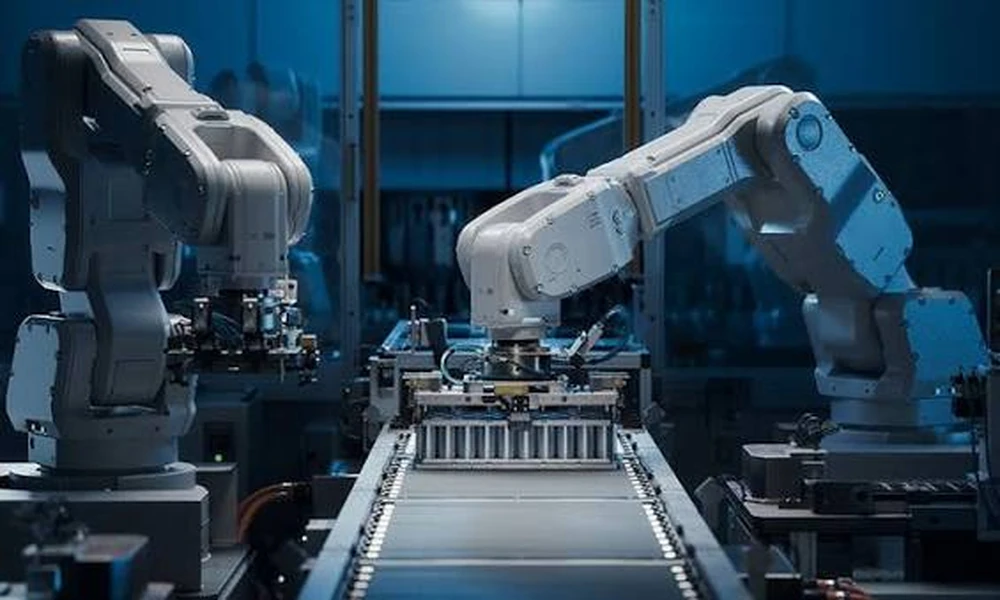
Industrial robotics has traditionally been closely tied to hardware. Choosing a robot often means choosing its controller, programming language, engineering software and associated ecosystem. Once a factory has built several cells around one manufacturer, changing platforms can become expensive because the knowledge and application code are difficult to transfer.
Software-defined robotics proposes a different architecture. The robot remains physically important, but more of the application intelligence sits in a separate software layer that describes what the machine should accomplish rather than encoding every behaviour directly into one manufacturer’s environment.
What is being “software-defined”?
The phrase software-defined robotics does not mean that hardware becomes irrelevant. Payload, reach, speed, accuracy and safety capabilities continue to determine what a robot can physically do.
What changes is where the task logic lives. A software-defined architecture separates manufacturing intent from some of the brand-specific commands needed to execute it. Functions such as picking a part, loading a machine or reacting to production events can be represented at the platform level and then executed on supported robot hardware.
This creates the possibility of reusing more application logic across different systems.
Robot-agnostic is not the same as robot-universal
This distinction is essential. A software platform may be designed independently of any one robot brand, but it still requires validated interfaces for each controller it actually supports.
Trener Robotics makes this distinction in its own explanation of the concept. Acteris has a robot-agnostic architecture, while the company currently lists ABB, Universal Robots and FANUC as supported brands. The architecture is intended to simplify expansion to additional manufacturers, but it does not imply that every robot on the market can already run the platform. For buyers, actual controller compatibility matters more than broad terminology.
Why standardisation matters to integrators
System integrators frequently build cells around different robot brands according to customer preferences or technical requirements. Without a common application layer, much of the programming and commissioning work has to be recreated for each environment.
Reusable skills can reduce this duplication. A machine-tending application still needs project-specific configuration, but the fundamental behaviours do not necessarily need to be engineered from scratch every time.
Trener positions Acteris around this principle, offering reusable robot skills and standardised runtime behaviour intended to help integrators deploy similar applications across multiple installations with less custom code.
The potential benefit is not just faster commissioning. A more consistent software structure can also make later support and maintenance easier.
Existing robots may be part of the opportunity
Software-defined robotics is particularly interesting when factories already own substantial automation hardware. A mechanically sound robot may still have years of useful life even if its current application is no longer required.
If the existing controller is compatible, a higher-level software platform may make it easier to redeploy the robot for another task. This creates a potential brownfield use case in addition to new installations.
Compatibility still needs to be verified individually. Robot age, controller generation, safety architecture and external equipment can all influence whether a retrofit is practical.
Hardware differences never disappear completely
A software abstraction layer can standardise task logic, but it cannot turn all robots into identical machines. A six-kilogram collaborative arm and a large industrial robot still differ fundamentally in payload, reach and operating behaviour.
Tooling and fixtures may also need to change when an application moves between robots. Cycle time can be different even when the same high-level skill is executed.
Software-defined robotics should therefore be understood as a way to reduce dependence on brand-specific application code, not as a method of making hardware interchangeable.
Its greatest value is likely to appear in factories and integration businesses that deploy many robotic cells and want more of their engineering work to remain reusable. In that context, shifting application intelligence from individual controllers into a common software layer can change both the economics and maintainability of automation.
